
To view this presentation in PDF format, click here.
ACA Town Hall Evening | Geneva
May 7, 2014
Jonathan Lachowitz
Financial Planner - Investment Advisor
This presentation is not meant as legal, tax or financial advice to any individual. You are strongly recommended to seek the advice of a professional who understands your specific circumstances before relying on any of the information in this presentation. There may be mistakes and regulations may change or not apply in some circumstances. The presentation may be circulated but should be appropriately cited if used in a professional setting.
IRS Circular 230 Disclosure: Any tax advice in this communication is not intended or written by the author to be used, and cannot be used, by a client or any other person or entity for the purpose of avoiding penalties that may be imposed on any taxpayer.
Introduction
Jonathan Lachowitz
Board Member ACA
Financial Planner & Investment Advisor
Certified Financial Planner ™ -US & CH
Founder of White Lighthouse Investment Management in Lausanne & Lexington, MA
Agenda & Additional Material
Swiss Banks Request for Information from US Citizens
Top 10 Personal Financial Challenges for Americans in Switzerland and How to Address Them
Retirement Planning for Americans in Switzerland – Should I Stay (In Switzerland) or Should I Go (Back to the US)?
What’s new for taxes in 2014
Back-up Slides
Being a Smart Financial Consumer
Tips for American Expatriates
Money Management - Essentials
American Taxes - Living in Switzerland
Money and Children
Estate Planning
Government & Employer Benefits
Common Financial Questions
Retirement - How Much Do I Need?
Swiss Banks Request to US Taxpayers for Personal Tax Info
FATCA – The “why” the banks are asking
DOJ & Swiss Government Joint Statement: August 29, 2013
Your Choices in Responding
A Brief History
The Foreign Account Tax Compliance Act (FATCA), introduced as part f the HIRE Act and enacted into law by the 111th Congress on March 18, 2010, is designed to compel foreign financial institutions (FFIs) and non-financial foreign entities (NFFEs) to provide information to the US Internal Revenue Service (IRS) about US persons who hold accounts with or interests in FFIs and NFFEs.
FATCA was meant to combat offshore tax evasion and to recoup federal tax revenues.
Under US tax law, US persons are generally required to report and pay taxes on income from all sources regardless of where they live.
The IRS previously instituted a Qualified Intermediary (QI) program under Internal Revenue Code §1441 which required participating foreign institutions to maintain records of the US or foreign status of their account holders and to report income and withhold taxes. One report found that participation in the QI program was too low to have a substantive impacts as an enforcement measure and was prone to abuse: As has been demonstrated by UBS and Credit Suisse as well as the relatively small number of Overseas Americans filing tax returns and FBARs.
FATCA in 1 Minute – For Individuals
From the 2011 tax return, the form 8938 needs to be completed with your US tax return. For taxpayers living abroad:
Joint return – $400K in specified foreign assets or more than $600K during the year
Other than joint return – $200K in assets or more than $300K during the year
Swiss Banks will be reporting to the IRS account information for US persons – US-Swiss IGA signed 13-2-2013: Starting for the year 2014, first reports probably sent in 2015
Savings & investment accounts will be reported
2nd and 3rd Pillar accounts should not be reported
Your Swiss financial institution will ask you (if they have not already) for a W9 to confirm your US Social Security Number and for your permission to send info to the IRS
If you have not reported your accounts on FBAR & 8938 and/or have not reported the income on a US tax return, you should talk with a US tax/legal professional before the IRS receives your information
Some [local FFI} Swiss Financial Institutions will not be allowed to discriminate against US persons living in Switzerland
DOJ & Swiss Government Joint Statement: August 29, 2013
DOJ announces program to encourage Swiss banks to cooperate in DOJ investigation of offshore tax evasion
Swiss government encourages all Swiss banks to participate in the program
Available to banks not currently under criminal investigation:
Agree to pay substantial penalties
Make a complete disclosure of their cross-border activities
Provide detailed information on an account-by-account basis for accounts in which US taxpayers have a direct or indirect interest
Cooperate in treaty requests for account information
Provide detailed information as to other banks that transferred funds into secret accounts or that accepted funds when secret accounts were closed
Agree to close accounts of account holders who fail to come into compliance with US reporting obligations
Banks meeting criteria exchange information & money for non-prosecution (category 2) or non-target letters
Link to full text of statement: : http://www.justice.gov/opa/pr/2013/August/13-tax-975.html
Link to program: : http://www.justice.gov/iso/opa/resources/7532013829164644664074.pdf
Banks will pay a penalty of between 0% and 50% of the US tax payers maximum account value
Banks want your help in getting them to 0% that is why they are asking for information
Banks are generally asking for FBARs, an attestation from the client, and tax advisor that the accounts and income have been properly reported to the IRS and Department of Treasury
Banks are also asking for clients to give up certain Swiss rights with respect to the handling of their private information
In some cases, banks are asking for copies of tax returns
In some cases, banks are blocking access to client funds
What to give your banks or former banks?
| Do you want to keep your banking relationship? | |||
|---|---|---|---|
| YES | NO | ||
| Are you US tax compliant? |
YES | - Give info requested - Redact info not related to that bank - Consider not giving up Swiss Privacy rights |
- Give info requested if you want to be nice; redact info not related to that bank - No obligation especially if you have no money left there - Your name may end up on a "list" so keep good records |
| NO | - Get compliant and likely with a professional - Then see box above |
- Get compliant and likely with a professional - Your info may be handed over and this may get you in trouble |
|
In most cases, it is reasonably likely that your information could be sent to the US government, but it may take awhile.
Swiss Banks Request to US Taxpayers for Personal Tax Info
More information available
Full article: : http://americansabroad.org/files/6013/8618/6297/swiss-banks-versusus-citizens.pdf
Abridged version, Ellen Wallace at Geneva lunch: http://genevalunch.com/2013/12/03/banks-ending-year-with-letters-to-us-clientsupdate/
Top 10 Personal Financial Challenges for Americans in Switzerland and How to Address Them
1 – US Tax Compliance – Keep up with ever more complex rules
File your tax returns including worldwide income, pay your taxes on time and file your FBAR/FinCEN 114 and you will avoid 90% of “problems” that overseas Americans run into
Net page has some of the most common overseas tax forms
Employer and employee contributions to retirement accounts are taxable in the US (flaw in the treaty) – Track your US tax basis
Owning non-US investment funds is for most US taxpayers a recipe for trouble, especially without a tax advisor and even in 3rd Pillar accounts
Even the most “simple” situation can be challenging to report properly
2 – US Tax Planning – Using the rules in your favor
If you have earned income and it is not all excluded, you can make a tax deductible IRA contribution
Having a year with no income or low income for the US, consider a Roth conversion of US retirement accounts
Watch how your investments are structured: ETFs are often better than similar Mutual Funds due to less capital gains distributions
Consider gifting and/or titling of accounts especially if married to a non-citizen spouse
3 – Saving for Retirement
By far the most important thing is to save, regularly, this will have the biggest impact on your retirement
Don’t “save” on Swiss taxes only to increase your US taxes
TRACK YOUR US TAX BASIS in your 2nd and 3rd Pillars to help avoid double taxation in retirement
Retirement savings in a non-tax-deferred account has other tax and non-tax advantages; Capital gains treatment is better, diversification, and personalization of strategy is possible
Whether in Switzerland or the US, you will probably live longer than you think (on average); and Switzerland still has a mandatory retirement age for most jobs; You may need to be saving more than you think
Understanding of how US Social Security and Swiss AVS rules can work for or against you, especially with the deferral of benefits
4 – Estate Planning
Your US Will may not be executed the way you are expecting if you die in Switzerland
If you are not Swiss you can elect to have your home country law apply
A Swiss notary or attorney can help you get your paperwork in order
Switzerland has forced heirship rules, which means your children will inherit some of the estate upon the death of the first parent…Unless you choose items 2 and 3 above.
5 – Insurance – Especially for life insurance
Life insurance is most valuable in the currency it would be needed
US taxpayers should try to avoid building cash values or investing in non-US compliant life insurance
Consider having a spouse own the policy for US estate planning purposes
Medical insurance is private in retirement in Switzerland; Medicare with supplemental insurance can be a reasonable alternative, but not available outside the US
Term insurance is generally far cheaper in the US but most US companies cannot sell insurance to Swiss residents
6 – Investment Management Services
Difficult (not impossible) to find comprehensive advice for US persons at a reasonable price if Swiss domicile of account is preferred
Strongly consider using a US investment account; prices tend to be far more competitive, you can own most Swiss investments in a US-based account
Being SEC registered does not mean a firm has any particular competence in working with US persons
Do your homework and be clear about what type of advisor you are looking for – Many (in the US and Switzerland) are strictly sales people with a fancy title
7 – Finding Professional & Trustworthy Services – Also at reasonable price
If your bank/banker has asked you to leave because you are a US person, use this as an opportunity to go through a good selection process – Far too many people research a new restaurant more than they do their advisors
Get references and follow through
The community of professional advisors who serve US persons (tax, legal, financial, etc) is small – Sometimes going outside the country can help
Most good advisors don’t need to advertise and don’t need to look for new clients; they can also afford to reject new clients who are not good for their business
8 – Managing Currency Risk
Holding cash in one currency that will need to be spent in another currency is risky (exchange rates)
Holding cash for “long term” investment in the currency it will be spent is risky (inflation)
Global stocks including a large part of the SMI are highly correlated to the US Dollar, not the Swiss Franc
Nestle, Novartis, and Roche – Buying shares in a company that are denominated in Swiss Francs are not much “safer” than holding stocks in dollars or euros
Holding dollars for the last 40 years you saw the dollar go from buying 4 Swiss Francs to buying less than 1 Swiss Franc; holding shares in the S&P saw an annual return, in Swiss Francs of close to 10%
9 – Real Estate
Make sure you understand the income tax implications in the US of your Swiss real estate in terms of: mortgage, interest deduction, the sale of your home (capital gains or losses), and the paying off of your mortgage (capital gains and losses)
This is a big shock to lots of US persons, see your tax advisor for good advice
The main reasons people make money in real estate is leverage and forced savings (to pay down a mortgage) over a long period of time – Luck helps
The main reason people lose money in real estate is leverage, unfortunate timing, and too short a time horizon
10 – Feeling Powerless to “Change the System” to Be More Fair
Join ACA (or better, volunteer for ACA) and encourage your friends to join too - A very small organization with very little funding but lots of passion; has a voice in Washington and in the US press; and it is increasing
Vote in Federal Elections & contact your representatives in Congress
Contact the US Embassy
Talk to the press
Nothing will change in Washington DC without individual citizens working for change
Summary for Foreign Information on “Common” US Tax Forms
Form 3520 – Annual Return to Report Transactions with Foreign Trusts and Receipt of Certain Foreign Gifts, de on the date that the taxpayer’s individual income tax return is due (generally April 15), including extensions
Form 3520A – Annual Information Return of Foreign Trust with a US Owner, generally due March 15
Form 5471 – Information Return of US Persons with Respect to Certain Foreign Corporations, attached to and filed with the taxpayer’s income tax return
Form 8621 – Return by a Shareholder of a Passive Foreign Investment Company or Qualified Electing Fund, attached to and filed with the taxpayer’s income tax return
Form 8865 – Return of US Persons with Respect to Certain Foreign Partnerships, attached to and filed with taxpayer’s income tax return
Form 926 – Return by a US Transferor of Property to a Foreign Corporation, filed with the taxpayer’s income return
Form 8621 – Must be filed for each PFIC held each year
Form 8832 – Entity Classification Election, often filed for a foreign company to elect disregarded entity status; thus, the tax responsibility flows through to the owner so tat there is no tax at the company level
Form 8858 – Information Return of US Persons with Respect to Foreign Disregarded Entities, filed with taxpayer’s income tax return
Form 8891 – Information Return of US Persons for Beneficiaries of Certain Canadian Registered Retirement Plans
Form 8938 – New form to be included with tax return for individuals with foreign assets over $50,000
Form TD F 90-22.1 New FinCEN 114 – Report of Foreign Banks and Financial Accounts, filed by June 30 of each year when, in the previous year, the taxpayer had a foreign bank or financial account with over $10,000 (for a discussion of recent changes to this form please see “IRS Releases Revised Foreign Bank Account Reporting Form”)
Form 2555 – Foreign Earned Income, generally due by April 15 for US citizens and resident aliens living abroad to exclude a certain amount of foreign earnings from taxes and/or to claim the housing exclusion
Retirement Planning for Americans in Switzerland – Should I Stay (In Switzerland) or Should I Go (Back to the US)?
Often a lifestyle not a financial decision
Crossing borders presents threats and opportunities
Cost of living: Matching income to expenses - Currency
Tax system
Health Benefits
Language
What’s New for US Taxes in 2014
Gift and Estate Tax Limits
Tax Summary Pages 1-6
2014 Gift & Estate Limitations
Annual gift exclusion amount increased to $14,000 in 2013 from $13,000; Remains at $14,000 for 2014
Federal Estate Tax (Lifetime Gift Exclusion amount) $5.3 million and indexed annually for inflation
2014 Gift Exclusion amount to non-citizen spouse increases to $145,000 (up from $143K in 2013)
Federal Estate Tax is not scheduled to sunset though the President has already proposed reducing it
2014 Tax Summary – What’s New
FEIE – $99,200 for 2014
Top US federal tax rate 39.6% for income $457,600 and up (married filing jointly, $432K HOH, $406K single)
http://forbes.com/sites/kellyphillipserb/2013/10/31/irs-announces-2014-tax-brackets-standarddeduction-amounts-and-more
US Long Term Capital Gains rate - 20%
Medicare surcharge (Obamacare tax) 3.8% – for joint filers > $250K, for individuals > $200K
Itemized deductions & personal exemptions phase out for individuals earning > $245K and couples earning > $305K
AMT has been “permanently” inflation adjusted
Personal exemption is $3950, but starts to phase out at $350K, completely phased out for income above $427K (both limits for MFJ, less for individuals)
Kiddie Tax – Children can earn $1000 with no taxes, up to $2000 at reduced rate and over $2000 at parents rates
$5500 IRA contribution limit (traditional IRA) $6500 if over 50 years old
Federal gift tax exclusion $14,000
Federal estate tax exclusion (for US persons) $5,340,000 – Only $60,000 for non-US persons holding US situs assets – Federal estate tax rate 40%
Obamacare
Net investment income tax: 3.8% on the lesser of
Your net investment income
The amount of your modified adjusted gross income (basically, your adjusted gross income increased by an amount associated with any foreign earned income exclusion) that exceeds $200,000 ($250,000 if married filing a joint federal income tax return, $125,000 if married filing a separate return)
Effective 2013 tax year and does apply to foreign income
For 2013 tax returns, if you are a high-income wage earner, [over $250 MFJ] with a W-2 [and self-employment income] at the end of the year, you will have a .9% ‘Additional Medicare Tax’ (AdMT) on income over $200K. This will be reported on new IRS Form 8959. [Effective 2013 tax year and does not apply to foreign income] and will not be matched by employers
No mandatory health insurance if you live outside the US
FBAR
FBAR and FinCEN 114 can only be e-filed on the FINANCIAL CRIMES ENFORCEMENT NETWORK
http://bsaefiling.fincen.treas.gov/NoRegFBARFiler.html
The old FBAR form TD F90-22.1 will be replaced by the FInCEN 114. The TD F form had 3 pages of instructions
The FinCEN 114 has 19 pages of instructions
If your tax status is MFJ you must also prepare FinCEN 114 – Both spouses having to sign this form
If your computer does not use a Windows operating system, you cannot access this site
If you use either Firefox or Google Chrome as your browser, you might have difficulty accessing this site
If a ‘third party’ (ie tax preparer) will be e-filing for you, you must present a signed FinCEN 114A to that preparer
Form 8938
Specified foreign financial assets must be reported on this form – There are filing level ‘differentials’ with lower amounts for US domiciled filers and expat filers:
MFJ overseas: $US400,000 balance for all specified foreign financial assets as of 31 Dec 13 or balances on any day during the year that value was $US600,000
MFS or Single overseas: $US200,000 at 31 Dec or $US300,000 as highest aggregate amount during the year
The 2012 Form 8938 was 2 pages – The 2013 version is 3 full pages
There is a 12-page set of instructions, with examples, explaining what is considered a specified foreign financial asset
Passive Foreign Investment Corporations – PFICs – Non US Investment Funds
Form 8621 – For filing by the Shareholder of a Passive Foreign Investment Company or a Qualified Electing Fund
This includes any business investment with under 10% ownership but with a market value of over $US25,000
At the end of 13 pages of instruction for this form, the IRS estimates that it will take a PFIC owners 15 hours, 4 minutes for annual record keeping; 11 hours, 13 minutes for learning about this form; and 20 hours, 21 minutes for form preparation and filing…Just for owning an investment outside with an end of year value of $US25,000.
PFIC taxation
Preferred Method is Market to Market (assume it is sold at the end of each year and report income annually) – No Long Term Gains Treatment
If not Market to Market, other options include getting the funds to report “properly” for the US or possibly paying large taxes and penalties if profitable and held for a long time.
Message: It is not worth owning PFICs for 99% of Americans overseas
Concluding Thoughts
Time and education are your best assets
Are you passionate about what you are doing? If not, what are you doing about it?
Are you saving enough? Save early and often – Time Value of Money is a Miracle
Are your expectations realistic?
Remember Risk vs Reward – There is no such thing as a free lunch
Keep fees and expenses low – But not too low
Find professional help when you need it – Hire people who are more qualified than you: A financial planner can help you stick to your plan!
Understand the real difference between gambling and investing
Don’t expect government, company, family, or children to take care of you: If they do, that’s a bonus – You are in the driver’s seat
Don’t look at your portfolio too often
Things change, be prepared!
Back-Up Slides
Being a Smart Financial Consumer
Investment of your time – even if the subject is not interesting
Together with your spouse or partner
Educate yourself
Hiring a professional where specialists are needed
You will need to pay for most good professional advice
Being a good client – Most good advisors choose you as much as you choose them…Be respectful, honest, and timely
E.g. If you have had 5 new tax advisors in 5 years, the problem may not be the tax advisors
The Swiss expat community is small
Know your costs
Know your rights and obligations
Comparison shopping
Choosing a Financial Advisor
Do you need a financial advisor or planner? Why?
What is a financial advisor? Different titles…
Whose interests do they put first? Are they a fiduciary, employee, or salesperson?
What are you looking for and what do you think you need?
A financial plan?
Investment advice?
Retirement advice?
Get references from people you trust – Ask the one thing your reference does not like
What licenses, education, registrations do they hold? CFA, CFP®, CHFc, or PFS (for CPAs) are some of the most respected.
What experience do they have? Would you be a typical client?
How does the advisor get paid?
Is their advice objective? How do you know? Are they paid more to sell their company’s product?
Will they consider or advise on assets not under their management?
Ask them if they can beat the market?
Have they been involved in any lawsuits, consumer complaints, or other disciplinary action?
Financial Advisor Checklist
Education and Qualifications
Is your advisor a fiduciary – putting your interests first?
How is your advisor paid?
Is your advisor qualified to give comprehensive advice?
Is your advisor a salesperson – Do they advise on products they are not selling?
Is your advisor upfront about “beating the market”?
Will your advisor try to prevent you from making mistakes?
Has the advisor been involved in any lawsuits or consumer complaints?
Full article at this link: 8 Things Your Financial Planner Won’t Tell You http://articles.moneycentral.msn.com/RetirementandWills/CreateaPlan/8ThingsYourFinancialPlannerwontTellYou.aspx
Tough Questions for Your Financial Advisor
What was your largest mistake in the past 10 years? What did you learn from it?
Do your financial incentives always line up with my best interests?
How do you manage conflicts between your goals as an employee and what is best for your clients?
Would you change your strategy for managing my account based on changes in the macro-economy?
Who in your firm actually makes the decisions on my account?
How have your client’s portfolios performed over the past 10 years?
If I wanted to buy a couple of broad based (low cost) index funds or ETFs, which would you recommend?
May I speak with one of your former clients?
If you ask for a referrals is more than one choice presented? And/Or an explanation of why a specific client name is given?
When was your last job change and why?
For US Registered Advisors
Investment Advisor Search: http://www.advisorinfo.sec.gov/IAPD/Content/Search/iapd_Search.aspx
Check out the firm and the individuals
They should offer a copy of their ADV 2 (firm and individual)
To verify CFP® certification –http://www.cfp.net/
Tell me about some of the outside professionals you work with: Do you pay or get paid for referrals? Do you disclose this generally to clients?
Ask about their regulations, auditors (when needed)
Ask about continuing education
Tips for American Expatriates
Get a regular copy of your free annual credit report +1 877 322 8228
Consider implementing a security freeze to prevent ID theft: http://redtape.msnbc.com/2007/11/now-a-way-to-st.html#posts
Get a regular copy of your US Social Security Statement: http://www.ssa.gov/
File your Annual US Tax Returns – It is now being checked upon passport renewal!
Keep a US credit card, with a US address
Keep a US address (for investing, credit cards & possible insurance)
Get a US phone number (Skype, call 800 number for free)
Review life insurance and long-term care insurance in the US
Review a US-based will
Investigate what happens if you were to die while living overseas (Swiss law is different than US)
If you plan to return to the US, work with advisors who are experienced with the US “system” (financial, tax, legal, etc)
Travel to the US only on your US passport
Vote in Presidential elections (Federal OK, Local elections not advised from overseas)
Check out previous residence - “unclaimed property”
If you are married to a non-American, make sure you know the estate planning and gift tax implications – There are advantages and disadvantages
Money Management Essentials
Most important investment advice
Top money management essentials - mistakes
Risk
3 Ways to invest
List to asset classes
Most Important Investment Advice
Diversification
Dollar/CHF Cost Averaging
Time Horizon – Liquidity
Costs
Conflicts of Interest
Risk
Hard to define for most people
Loss of some or all of investment amount
Asset Manager – Uses measures such as standard deviation from “expected return”
Consider: time frame, inflations & your goals
Understand difference between risk and volatility
3 Ways to Manage Money
Market timing
Trying to decide where a market, particular security, or asset class currently is, where it may be going and when
Security selection
Choosing one investment over another
Asset allocation
Spreading the money in your portfolio between different types, or classes, of investments
| TYPE | PROS | CONS |
|---|---|---|
| Asset Allocation | - Investing not speculating - Proven long-term strategy - No guess work or emotions - Focuses on whole portfolio - Easy to manage |
- Boring - Won't get rich quick - Periodic rebalancing needed - Have to decide which classes - Inexperienced investors don't like some classes |
| Security Selection | - Fun and exciting to bet - If you are right a lot more than wrong, get rich quick |
- Too hard, too risky - Over 100,000 investments - Not enough time to do adequate analysis, even for the pros |
| Market Timing | - Fun and exciting to bet - If you are right a lot more than wrong, get rich quick |
- More risky and difficult than SS - Need to be correct >75% time - 1 in 8 "professional" timers beats the markets 3 years in a row |
Asset Allocation
Spreading money in your portfolio between different types, or classes, of investments
Asset Allocation accounts for between 75% - 90% of long-term portfolio performance
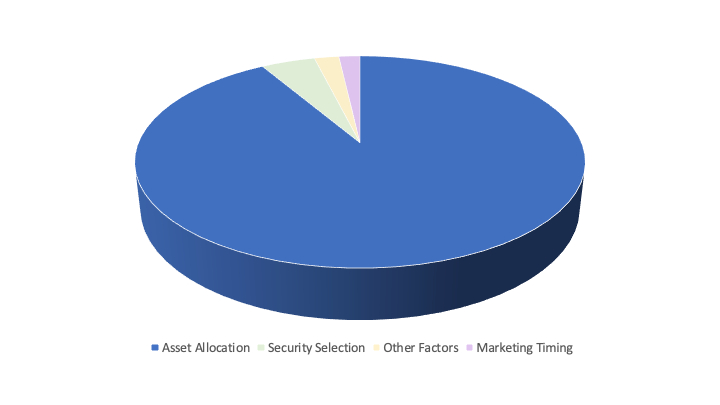
Gary Brinson, Brian Singer and Gilbert Beebower “Determinants of Portfolio Performance II: An Update, Financial Analysts Journal, May/June 1991
Major Asset Classes I Use
Cash
Short-Term Bonds
Intermediate / Long-Term Bonds
High-Yield (junk) Bonds
International Bonds
Emerging Markets Bonds
Large-Cap Value
Large-Cap Growth
All/Mid-Cap
Small-Cap
Technology
Biotech / Health Care
Micro-Cap
Internet
International / Global All-Cap
Emerging Markets
Real Estate
Tangibles
Money Management Essentials
| Essentials | Mistakes |
|---|---|
| Have a plan – Educate yourself or work with an advisor | Unrealistic goals, too general, undefined or unrealistic |
| Implement your plan | Procrastination |
| Pensions and investment earnings get taxed | Ignoring effect of taxes |
| Insure low frequency, low probability, high loss events | Having no insurance against death disability or liability |
| Diversification is a must: Don't significantly overweight | Over-weighted in current "fad" of investing: Tech stocks, real estate, employer |
| Inflation 3% long-term average minimum last 75 years | Ignoring inflation |
| Investment decisions based on: diversification, sticking to a plan | Making investments decisions based on emotions: fear & greed |
| Know what advice you need: good advisors are valuable | DIY – In order to save money |
| Know your ability and tendency to take risk: translate to portfolio | Too conservative or too aggressive |
| Diversification is essential | Concentration not diversification |
| Asset Allocation – Only reasonable long-term strategy | Not understanding Asset Allocation |
| Nobody can do it reliably, not even the "experts: | Trying to time markets |
| Cash is only one asset class | Too much cash |
| Someone who is an expert in one area does not make them an experienced investor | Over influenced by friends, family, TV, salesman, etc |
| By the time you hear about it, it is too late or illegal (insider info) | Placing bets on "hot companies" |
| There are no guarantees in investing: You pay to lose your money slowly (eg cash and annuities) |
Wanting everything guaranteed |
| If you and/or your spouse are not disciplined, hire an advisor | Lack of discipline |
| Long-term investing is a marathon, not a sprint | Wanting immediate results |
| Set reasonable expectations | Wanting something for nothing |
| Be cautious who you rely on for financial assistance | Over-reliance on others: inheritances, family marriage, lottery, home, etc. |
| Short-term: nobody knows where the market is going | Thinking that any one person knows where the market is going |
How risky is cash in the bank?
Is your “guaranteed” money really safe in the bank?
| $100 Principle x 4% Interest $104.00 EOY |
$4 Earned Interest 35% Marginal Tax Rate $1.40 Lost to Taxes |
$102.6 After Tax Value 3.5% Inflation $3.59 Lost to Inflation |
|---|---|---|
| $104.00 Nominal End of Year Balance -$1.40 Taxes Due -$3.59 Inflation $99.01 Real Value at the End of the Year |
||
Conclusion: Real loss of 1% in first year. Over 9.5% loss in ten years and 30% in 35 years!
You pay for certainty: no risk = no real return
American Taxes & Financial Planning
Living in Switzerland
Income taxes
FBARs
Gift & estate taxes
IRA accounts
2nd and 3rd Pillars
529 Plans
Over 90% of tax problems for overseas Americans can be avoided by timely filing of FBARs and tax returns as accurately as possible
Regardless of how “simple” you think your financial life is, it is generally more complex than you think
Income Taxes – Filing a US Federal Tax Return
All Americans with even small amounts of income need to file a tax return:
Generally with earned income over $10,000 ($20K married filing jointly)
More than $1000 in unearned income (higher if over age 65)
Self-employment income over $400
Church employee with income over $108
A return must be filed even if taxes are not owed (penalties can be high for non-compliance) – “I did not know the rules” is not generally an accepted answer by the IRS
The following link will help: http://www.irs.gove/Individuals/Do-You-Need-to-File-a-Federal-Income-TaxReturn%3F
Income Taxes – Types of Income Reportable
From employment (including benefits such as)
school fees
car allowance
some expenses reimbursed
employer contributions to non-qualified pension plan
Self-employment - Schedule C
Rental income (regardless of where rental property is located)
“Passive” income
Pensions - US and foreign, private and government
Interest, dividends, capital gains, market-to-market for PFICs
Other
Distributions from trusts or similar vehicles
Certain insurance and annuity contracts
Sale of collectibles: coins, art, metals, etc
Income Taxes – Miscellaneous
Inheritance received from a “covered expat” is taxable to the beneficiary
inheritance or gift(s) of over $100K cumulative in one calendar year from a non-US person (who is not a covered expat) is reportable (form 3520) but not taxable
Ownership of over 10% of a foreign corporation: 5471, different reporting for different ownership thresh-holds
FBARs
Financial Bank Account Reporting Form – Changing to FinCEN 114
Must file electronically now by June 30th every year, no extension
Must file if over $10K at any point cumulatively in any calendar year
Must file if signatory authority over accounts, even if no beneficial ownership
Traditional IRA Accounts
Individuals with earned income (not excluded) can contribute $5500 in 2013 ($6500 if over age 50)
Contributions are deductible, regardless of income level, if not contributing to a US qualified pension plan
Assets grow US tax deferred
Switzerland has the right but not the obligation to tax these accounts
IRA accounts can be opened at many US institutions for residents of Switzerland
Other IRA Accounts
Roth IRAs
Conversion to a Roth may be interesting if you are overseas and have no income (eg as a trailing spouse married to a non-US taxpayer)
SEP IRA
Can be used by self-employed overseas individuals
Inherited IRA
Make sure you understand minimum distribution requirements, penalties are up to 50% (not an overseas issue)
Converting to Roth IRAs
Traditional
Employer 401K
IRA Withdrawals
Age 59 1/2 for distributions without penalties
Age 70 1/2 for required minimum distributions
Misc IRA Info
Assets will not pass through probate; though difficulties can arise for non-US beneficiaries
Non-US beneficiaries may be able to receive distributions without any US taxes if lump sum taxation paid in Switzerland
Children can open IRA accounts and fund them if they have earned income
2nd and 3rd Pillar Accounts
Income is reportable annually in US
Contributions are not tax deductible in the US
Common error: Employer contributions are not reported as taxable income
To avoid double taxation, track your US tax basis in 2nd and 3rd Pillar accounts
Many 3rd Pillar and 2nd Pillar “libre passage” investments are PFICs
Don’t contribute to 3rd Pillar or excess 2nd Pillar “buybacks” if the result is a lower Swiss tax bill offset by a higher US tax bill
If you have money “stuck” in a 3rd Pillar, leave it in cash – USB from 2014 is forcing its US clients to do this anyway
529 Plans
Married couple can give up to $140,000 to a 529 plan in first year (5x Annual Gift Limitation)
529 Plan assets grow US tax free if used for qualified education
Over 350 foreign institutions qualify (eg. Lausanne Hotel School, University of Geneva)
http://www.savingforcollege.com/eligible_institutions/
PFIC – 3 Ways to Account
Sections 1291 through 1297 of US income tax code: Rules are essentially to discourage US people owning these types of investments
Most US people should avoid PFICs at all costs
Form 8621 must be filed each year (very cumbersome)
http://www.irs.gov/instructions/i8621/ch01.html3 ways to report income:
Get the fund to report under US reporting rules: segment interest, dividends, capital gains distributions, etc
Mark to market each year. Gains are taxed in year, losses not used to offset, future gains must be above high water mark (QEF Election: Qualified Electing Fund)
Gains pro-rated over several years of holding, taxes, interest and penalties due for all previous years
Money and Children
Money is still a taboo subject: Many families find it easier to talk about the facts of life than about money
Spend money and time in ways that are consistent with your values
There is no “one” correct way
Your children will be strongly affected by your actions
Follow your instincts
Educate yourself on what several “professionals” think
8 Steps to Raising Successful, Generous and Responsible Children
Encourage a work ethic
Get your money stories straight
Facilitate financial reflection
Be a charitable family
Teach financial literacy
Spend time and money in ways that are consistent with your values
Be aware of and moderate your extreme money tendencies
Engage in difficult financial discussions
Book: The Financially Intelligent Parent: Gallo & Gallo
Tips for Parents
Kids see and emulate more than we are aware of: Are your money actions in-line with values you would like to teach?
Don’t tie allowance to household chores
Give responsibility early:
Allowance: save, spend, invest, charity
Bank accounts
Credit card (for convenience)
Employment
Encourage & support: savings, investing, charity and spending
Financial training does not end when kids leave home…
Use the right language: Don’t say “we can’t afford it”
Include children in money discussion: Ensure they know how much things cost
Be open with your spouse
Emphasize doing your best rather than being the best
Don’t argue regularly about money in front of your children
Useful Resources
“The Financially Intelligent Parent” - Gallo & Gallo
Money Savvy Generation Website: http://www.msgen.com/assembled/home.html
Estate Planning
What happens to your assets when you or your spouse dies?
Estate Planning - Checklist
Do you have a will? Has it been updated?
Have you prepared an estate planning letter?
Do you know what will happen if you or your spouse die overseas?
Do you have enough life insurance?
Who will take care of minor children (raising them and finances)?
Do you have a listing of location of all valuable papers, assets, accounts, passwords?
If you have a business - continuity plan?
Insurance documents - updated including beneficiaries?
Do you have durable health care power of attorney, general power of attorney?
Do you have a living will?
Have you made your wishes known: heirlooms, location of burial, type of service, donations to charity, etc?
Do you need a trust arrangement: For sizable estates or take care of minor children?
5 Steps to Preparing Heirs
Assessing your wealth transition plan
Taking action on plan deficiencies
Preparing Heirs
The Heir’s self-preparation responsibilities
Continuing evaluation & measurement
Book: Preparing Heirs - Williams & Preisser
Government and Employee Benefits
Read the fine print – know your rights
http://www.ssa.gov/
http://www.bsv.admin.ch/
If you receive expat benefits: They don’t remain forever – schooling, health care, housing, car, etc.
Common Financial Questions
How much money do I need to retire?
How much money should I be saving towards retirement?
What age can I afford to stop working?
What percentage of my portfolio can I afford to spend in retirement?
Should I put all of my money into an annuity at retirement?
Should I invest in stocks?
How much emergency cash should I have?
In what currency should I invest?
Should I invest in real estate?
Retirement – Calculating How Much You Need
Life expectancy
Taxes
Inflation
Investment return
Spending needs
Percent covered by government & company pensions
Retirement Calculator
| White Lighthouse Retirement Calculator | Inputs |
|---|---|
| AnnualI Income Goal (Today) – After Tax | $100,000 |
| Percent of Income Covered by Govt + Company Pension | 40.0% |
| Years Until Retirement | 25 |
| Number of Years Required After Retirement | 30 |
| Inflation | 3.00% |
| Portfolio Yield - Before Taxes | 7.00% |
| Portfolio Yield - After Taxes - Before Retirement | 5.60% |
| Portfolio Yield - After Taxes - In Retirement | 5.25% |
| Average Tax Rate on Investment Earnings - Before Retirement | 20% |
| Average Tax Rate - In Retirement | 25% |
| When you retire, your annual income needs (from your portfolio) will be | $125,627 |
| In 25 years, we need a lump sum of (PV of Growing Annuity Stream) | $2,663,609 |
| Current Savings | $500,000 |
| Amount Needed to Save Each Year to Reach Goal | $13,711 |